Hypervision Cameras
The Hypervision HSI camera is a push-broom hyperspectral camera based on the qtec C-series platform.
All qtec cameras are a complete platform, combining imaging capabilities with a full Linux computer (CPU plus GPU) to allow for on-board image processing.
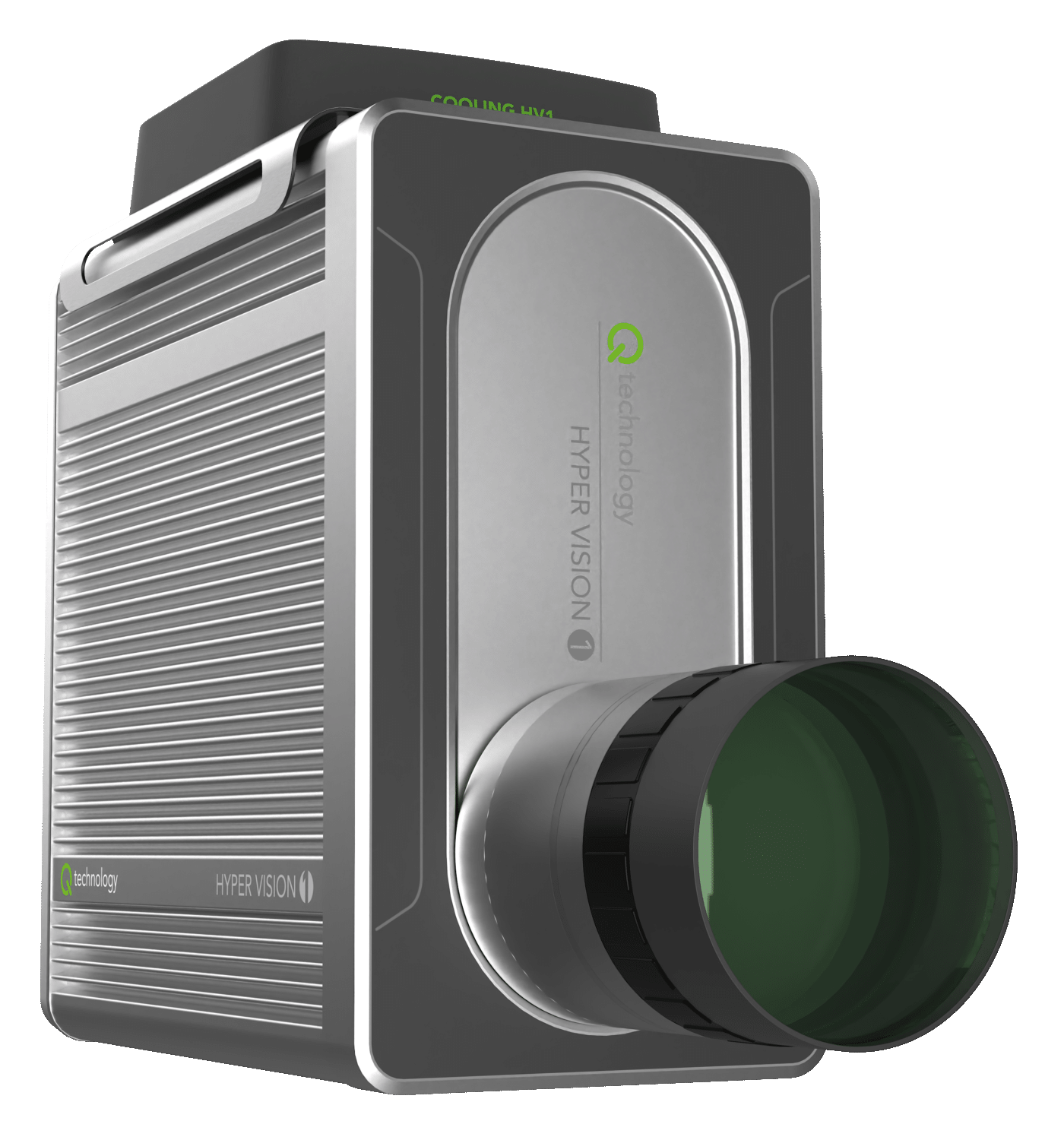
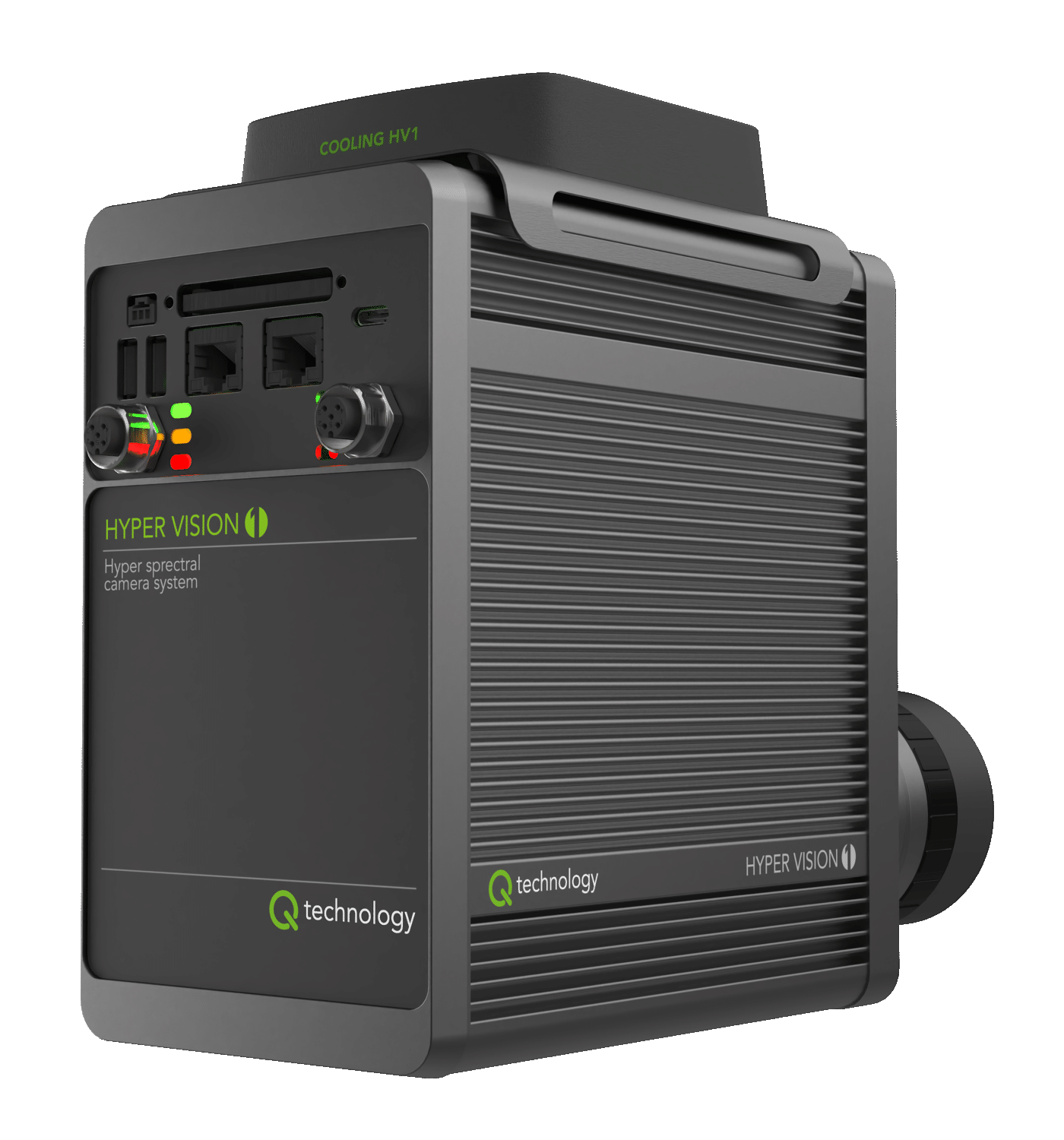
-
Two versions for either the VIS-NIR (430-1000nm) or the VIS-SWIR (430-1700nm) ranges
-
Different possible slit sizes to choose from: 20 (default) or 30um
- The slit size influences both the spectral and spatial resolutions
We are currently working on offering 2 different options of gratings in our Hypervision camera line.
The current high resolution one (with 65 lines/mm) and a new lower resolution option (with 24 lines/mm), which will allow for faster framerates (less bands) and improved light sensitivity as a trade off for the reduced resolution.
Technical details
Offner Spectrograph
The Hypervision uses an Offner Spectrograph instead of the more traditional approach that uses refractive (lens based) spectrographs. It's main advantage is its ability to provide a wide field of view with almost no geometric distortion and very low levels of aberration.
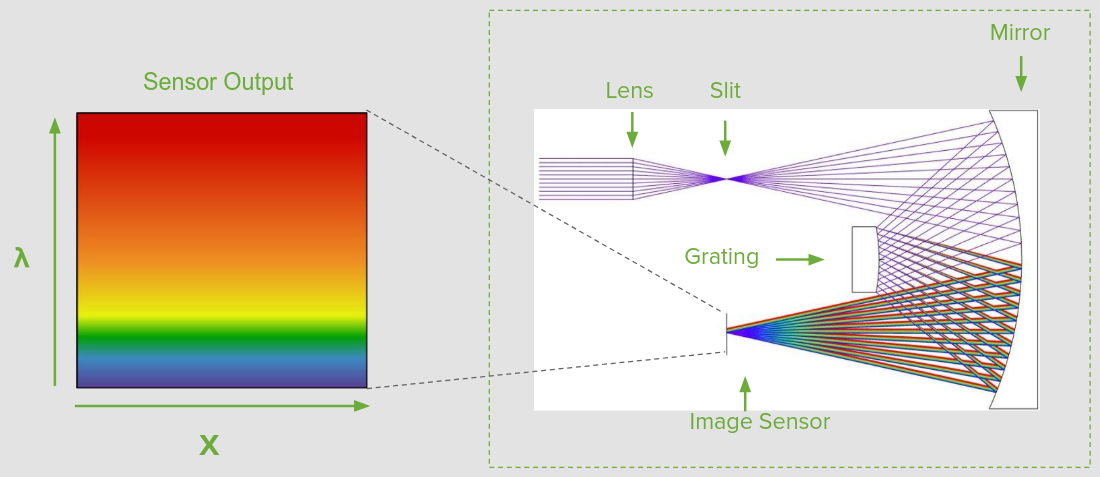
Offner Spectrograph
Zero "Smile" & "Keystone"
In many HSI cameras, the spectral image suffers from "Smile" (where a straight slit appears curved on the detector) and "Keystone" (where the spatial magnification varies with wavelength). The concentric, all-reflective nature of the Offner design inherently cancels these aberrations. This ensures that every pixel on the sensor represents a clean, undistorted relationship between a specific spatial point and its corresponding spectrum.
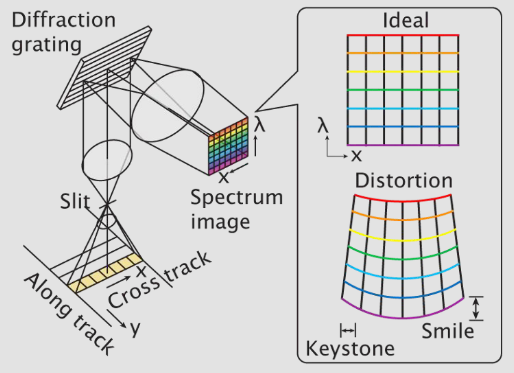
Smile and Keystone
Full-Spectrum Achromatism
Refractive systems (using glass lenses) suffer from chromatic aberration, where different colors focus at different distances. This requires complex, heavy corrective elements. Because the Hypervision uses mirrors and a reflective grating, the focal point remains constant across the entire spectral range. This allows for seamless imaging through the whole wavelength range without focus shift.
High Throughput and SNR
Traditional spectrometers often struggle with "stray light" or light loss at lens interfaces. The Offner relay provides a high Étendue (light-gathering capacity). By minimizing the number of optical surfaces and using high-reflectivity coatings, the Hypervision maintains a high Signal-to-Noise Ratio (SNR), even in low-light conditions or high-speed "push-broom" scanning.
Thermal Stability & Operating Environment
While the all-reflective Offner Spectrograph is inherently more stable than refractive (lens-based) systems, spectral precision is still influenced by the thermal environment. To ensure the highest levels of data integrity and calibration accuracy, users should consider the following ambient temperature guidelines:
The Hypervision is precision-calibrated at an ambient temperature of 22°C. For applications requiring maximum spectral stability and peak focus, we recommend maintaining an operating environment between 17°C and 27°C.
The camera is rated for reliable operation between 5°C and 40°C. When operating at the edges of this range (outside the optimal 17–27°C window), the system remains fully functional, but users may observe:
- Marginal focus degradation: Minor softening of spatial resolution.
- Spectral shifts: Nominal wavelength shifts (up to +-10nm) due to the thermal expansion of mechanical housings.
For most industrial and field applications, these variances fall within acceptable tolerances. However, for high-sensitivity laboratory analysis or quantitative chemical mapping, maintaining the optimal temperature range is strictly recommended.
Second order diffractions
Because the detector covers a broad spectral range, higher transmission orders from the diffraction grating become observable, causing overtones. The periodic structure of the grating produces multiple reflection orders, where the zeroth order contains the non-diffracted primary signal, and the higher orders spread the light based on wavelength.
As the detector captures this wide range of wavelengths, the higher orders can spatially overlap with the primary signal, resulting in overtones in the measurement.
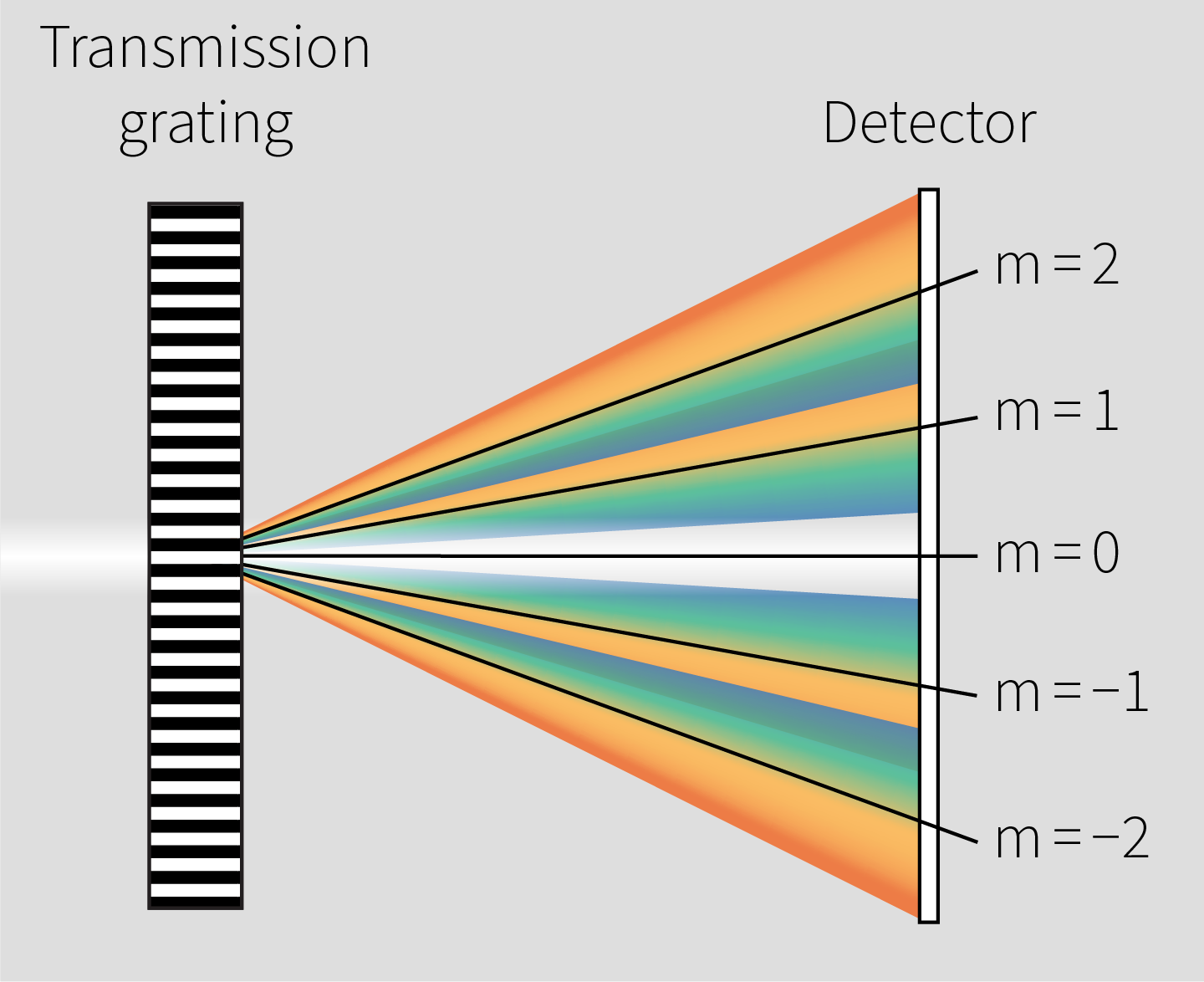
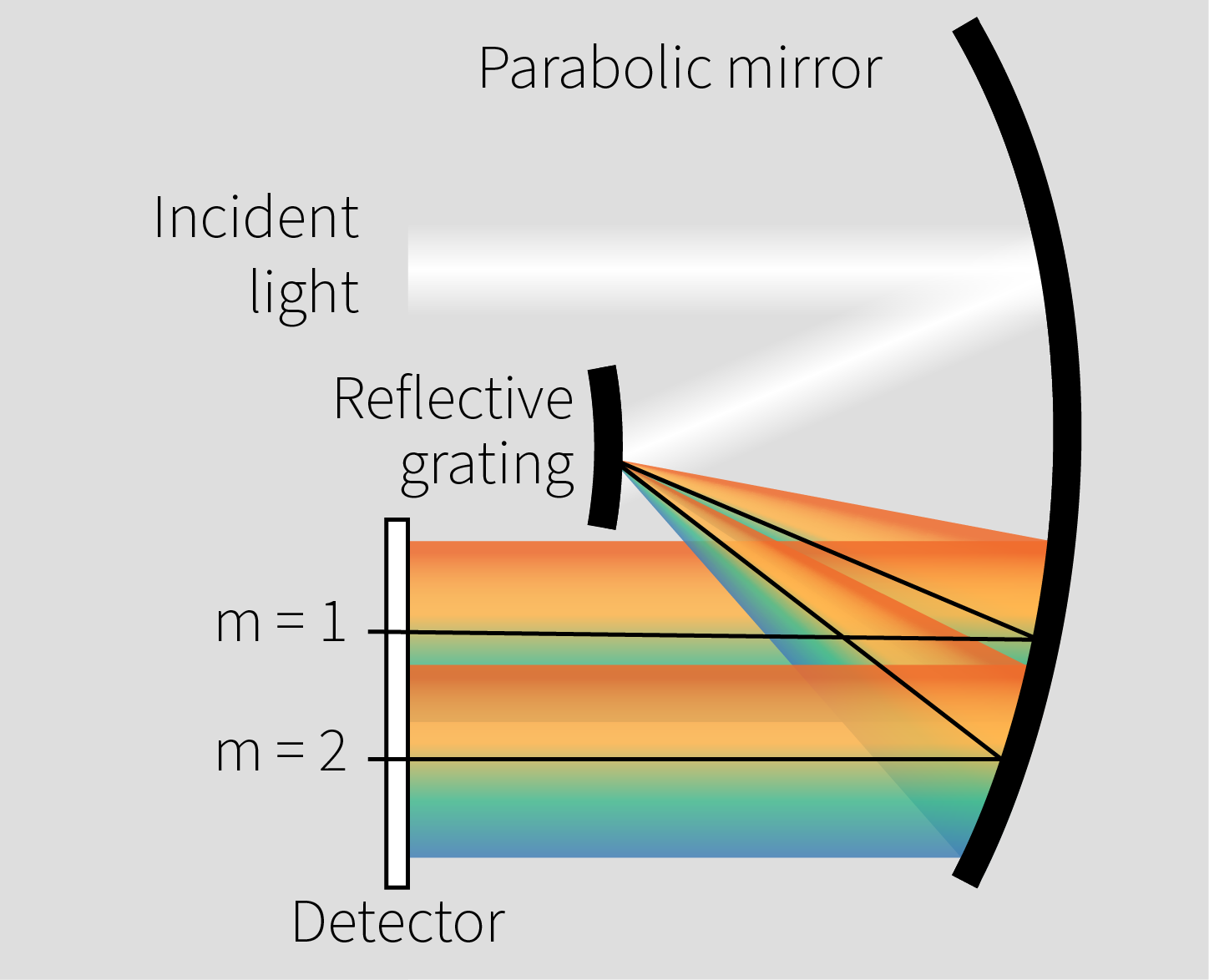
Multiple reflection orders caused by the grating
If necessary these effects can be counteracted by for example adding an external long-pass filter in front of the optics to limit the spectral range. It effectively removes the visible part of the spectrum and with it the overtones that it causes in the infrared range. Another similar option is to add a long-pass filter internally, covering only the bottom part (infrared range) of the sensor, in order to filter the visible range overtones.
However, since these methods introduce additional optical losses — thereby decreasing the signal-to-noise ratio — they are not included in the standard hardware setup.
Platform
| Hardware | Description |
|---|---|
| Model | qtec-C-series |
| APU | AMD Ryzen Embedded V1605B with Radeon™ Vega 8 Graphics [^V1605B] |
| Available sensors | Sony IMX990 or GSENSE2020 |
| Bitstreams | corna-tokyo/draco-tokyo or pisces-paris 1 |
Qtec is currently in the process of developing a new cheaper series of HSI cameras which won't have any internal processing capabilities and will be GigE Vision based instead.
Dimensions
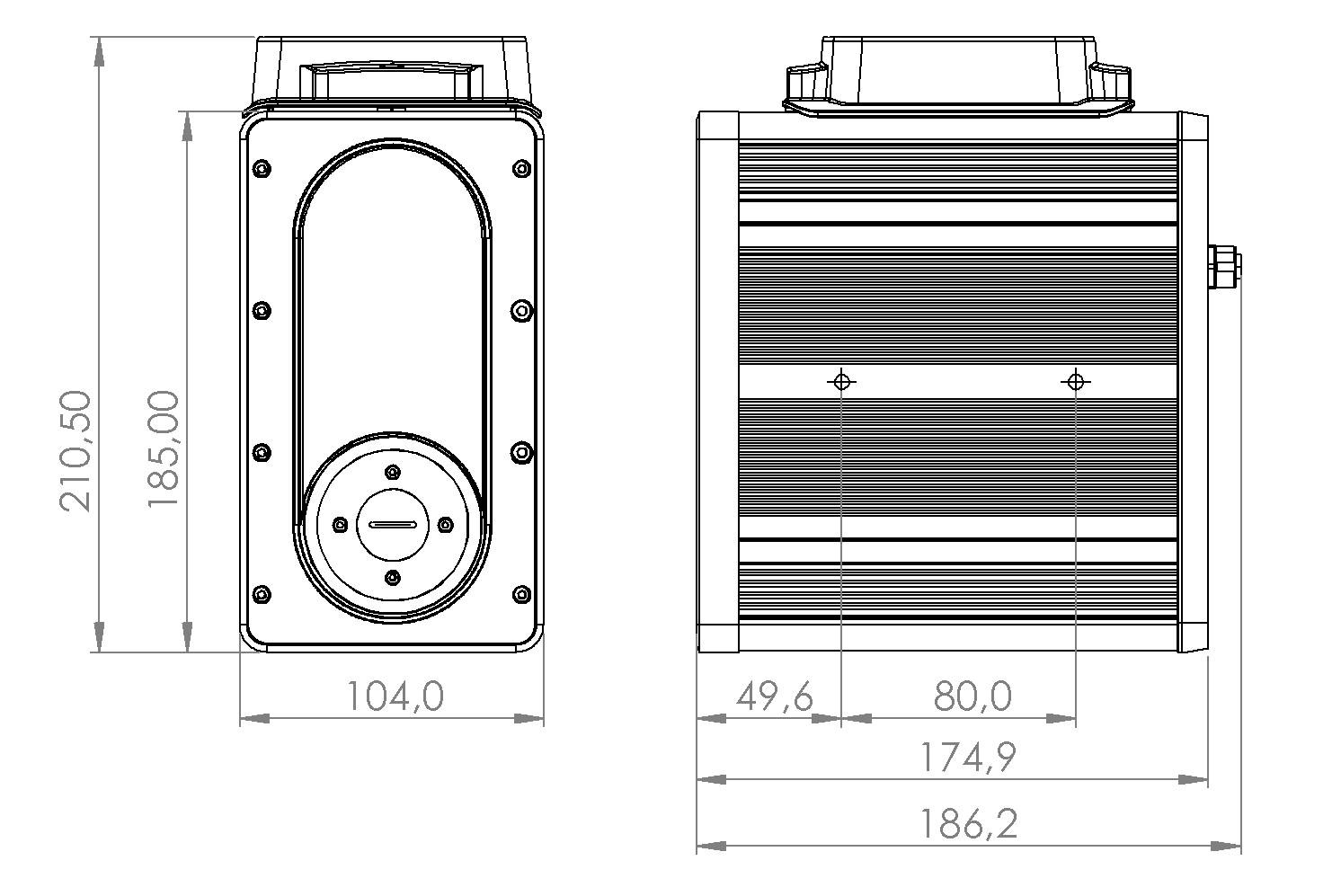
Hypervision dimensions
Mounting points thread: M6-6H X ↧ 6
Hardware interfaces
See the Quick Start Guide for basic information on how to power and connect to the camera.
Refer to the Hardware Guide for more detailed information on the available hardware interfaces.
Hypervision Software Suite
To streamline the development of hyperspectral imaging (HSI) applications, qtec offers a dual-layered software solution: HV Explorer and HV SDK. Together, these tools bridge the gap between initial data exploration and high-performance production deployment. See HV Explorer & HV SDK for how these tools work together.
HV Explorer: Rapid Prototyping & Visualization
The HV Explorer is a Python-based GUI designed for the exploratory "Proof of Concept" phase. It provides a comprehensive environment for visualizing and manipulating HSI data cubes without writing code. Key capabilities include:
-
Multiformat Support: Native handling of PAM, ENVI and TIFF files, as well as BIP, BIL, and BSQ interleave types.
-
Advanced Visualization: Individual spectral band slicing with custom colormaps and the ability to compose false "RGB" images from selected bands.
-
Data Processing: On-the-fly reflectance calibration (white/black references), SNV normalization, spectral derivatives, and smoothing (Gaussian, Savitzky-Golay).
-
Analysis Tools: Plot mean spectra for ROI comparison, use the PCA view to check ROI grouping in scatter plots and inspect PCA loadings, generate PCA component images with the PCA operation, and build clustering or simple ML classification and regression models.
-
Performance: Optimized for multi-image comparison and efficient RAM usage through the underlying SDK.
Note: The HV Explorer supports both offline analysis and direct live data capture in the v1.0 GUI, so users can acquire datacubes and continue analysis in the same application.
HV SDK: From Prototype to Production
While the Explorer is ideal for discovery, the HV SDK is the high-performance engine that powers it. Built in Rust, the SDK is designed for developers who need to transition a successful workflow from the GUI into a standalone, real-time application.
-
Live Data Capture: The SDK provides the programmatic interface for live data capture from Hypervision cameras, enabling immediate integration into production lines.
-
Memory Efficiency: Engineered with intelligent lazy loading to handle the memory expansion typical of HSI data. This allows for stable processing of large cubes (like those from the HV1700) and simultaneous operations on multiple datasets.
-
Interleave Agility: Includes high-performance functions to efficiently transform between and operate across all standard interleave types (BIP, BIL, and BSQ).
-
Language Support:
- Python (Full Support): Our primary focus; these bindings track the core Rust development closely to ensure immediate access to new features.
- C/C++ (On-Demand): Stable bindings are available based on specific release versions, with further updates prioritized according to customer requirements.